Schematic
From a scan to a hand that fits
The child's other hand is scanned for size
Patient-specific prosthetic hands
Children injured in conflict rarely reach a prosthetics clinic, and a commercial hand costs thousands of US dollars. The work builds upper-limb prostheses with desktop 3D printers, medical scans and parametric design, then tests what they can grip, how long they last and what they cost.
Testing an open-source printed hand against 33 human grasps
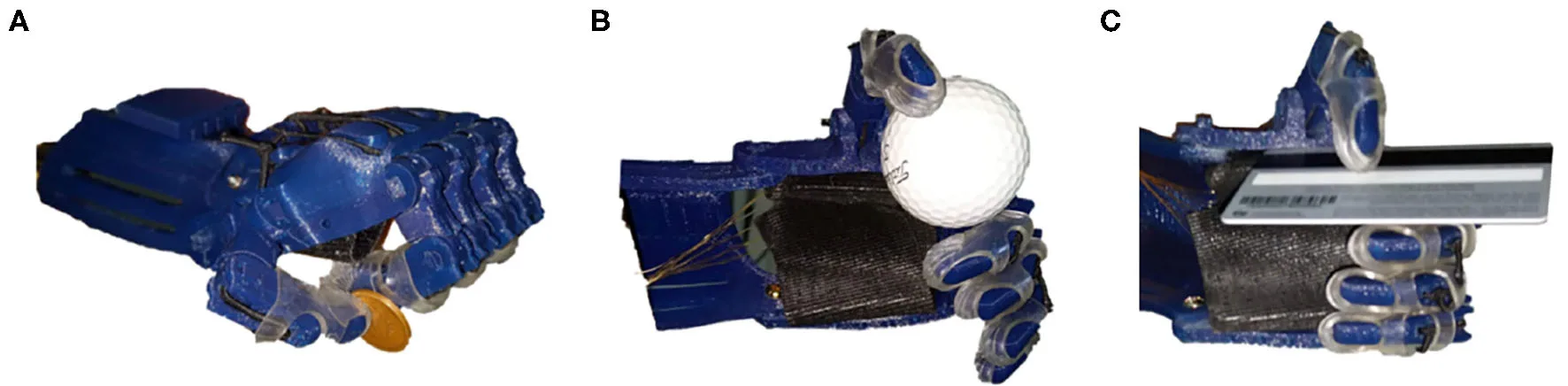
The 2021 study evaluated the e-NABLE Raptor Reloaded, the most widely used open design, worn by more than 1,500 amputees in 40 countries, against the 33 grasp types of the human hand. The printed hand performed three of them.
Grasp
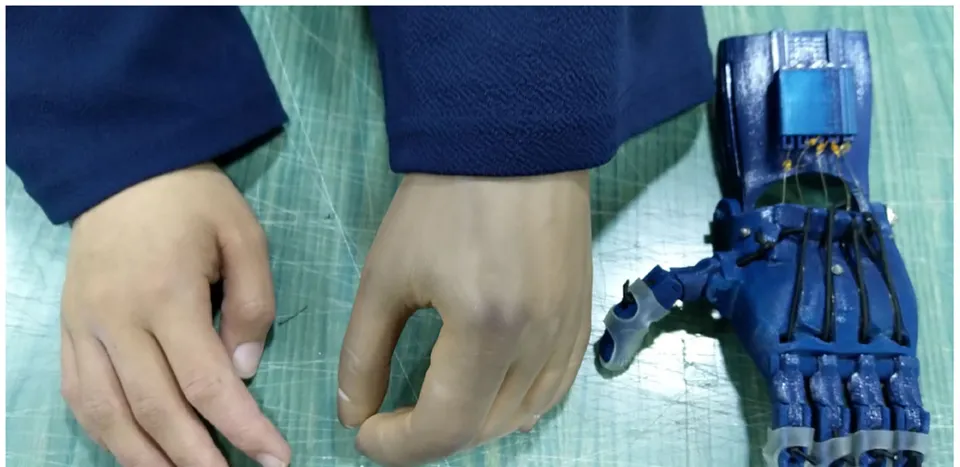
Wrist flexion tensions the cables and closes the fingers; elastic cords reopen them.
Joints
Printed phalanges joined by pins rest flat, with the hand fully extended.
Hand length 160 mm
Objects are shown at true scale. A parametric design rescales every part from a few measurements of the child's hand.
From a printed finger in Singapore to a full arm in Doha
A prosthesis that replicates the missing part lets the wearer pass unnoticed, which helps patients most in the early stages after limb loss. The method began with a finger at the National University of Singapore and extended to a full arm at Qatar University.
- ScanCT images of the affected and the unaffected side
- MirrorThe mirrored unaffected side defines shape and size
- DesignCAD models of the socket and the skin molds
- PrintMolds and support bone printed on a desktop printer
- CastSilicone skin cured around the bone
- ShipProsthesis shipped to the patient for fitting
Patient-specific prosthetic finger by remote collaboration
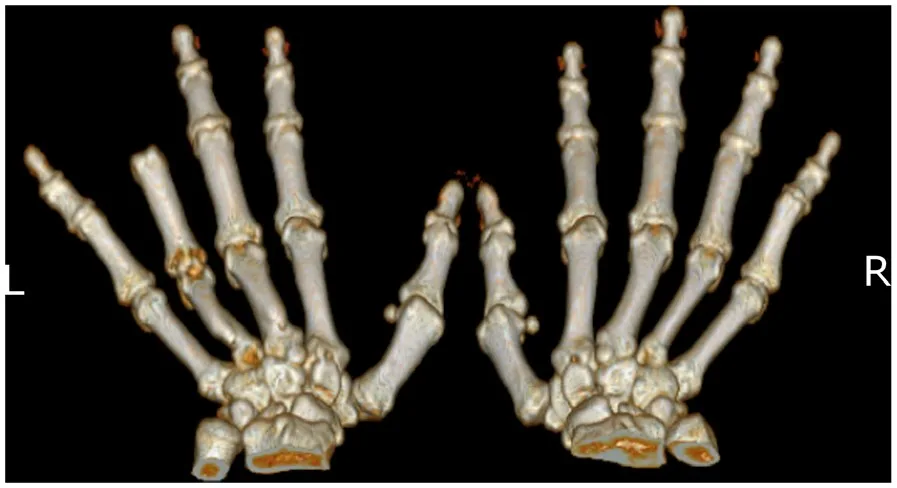
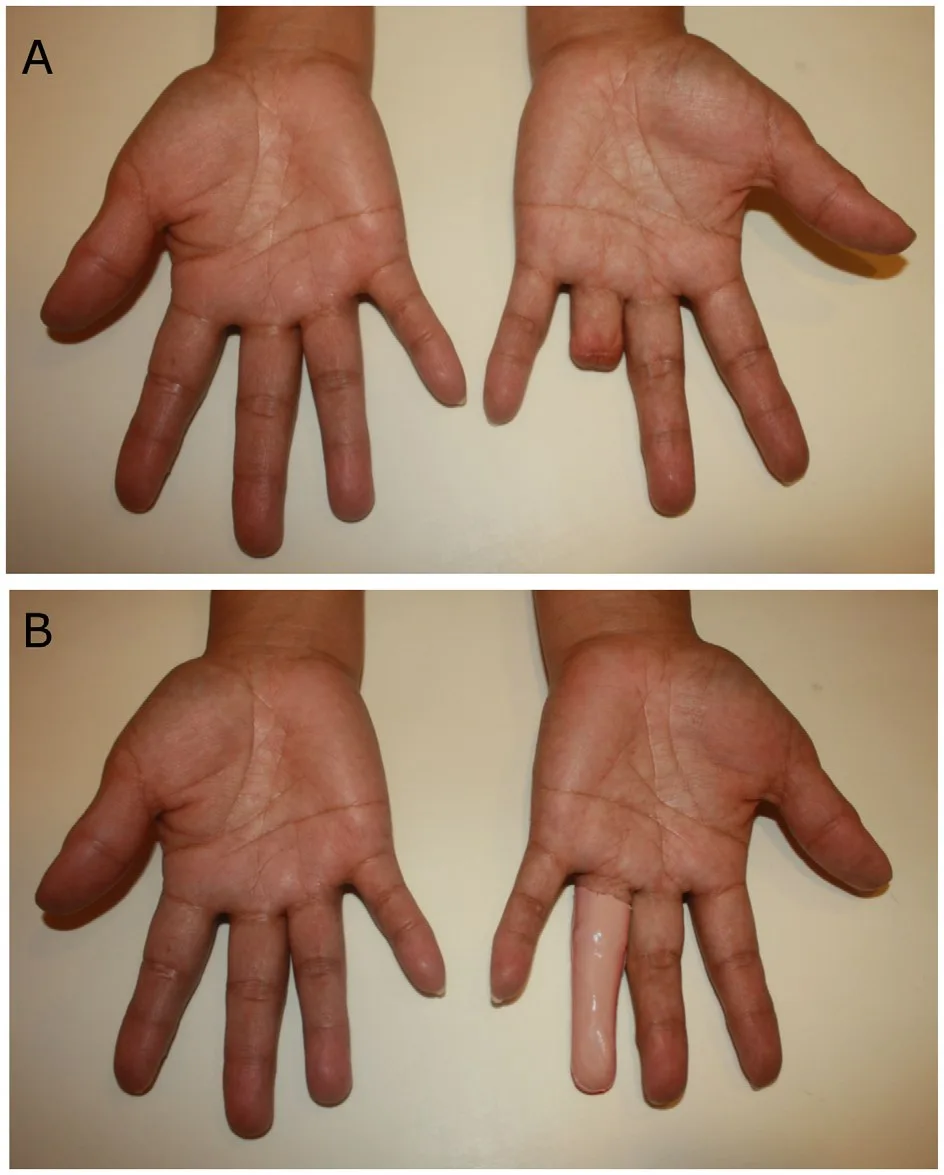
A patient sent CT data of a ring finger amputated 18 months earlier at the proximal interphalangeal joint. The finger, silicone over an artificial bone, was shipped without clinic visits.
Geometric accuracy of a patient-specific prosthetic arm
The socket reached a Dice coefficient of 0.95 and a mean surface distance of 0.46 mm. The patient reported the fit and shape as desirable.
Estimating how long a printed finger lasts
Finite element models, checked against filament tensile tests, estimated grasp cycles to fatigue failure. At 50 grasps per day, a PLA finger under 15 N lasts about four years; ABS fails above 10 N.
Source: Frontiers in Robotics and AI, 2021, Table 8. The raw data are on Data in Brief.
Pricing a printed hand against commercial ones
The printed hand costs two orders of magnitude less than a commercial prosthesis. Costs include a US$2,800 printer amortized over 10,000 h, 130 g of PLA at US$43/kg, cables, elastic cords, a part-time technician, maintenance and 17 h of electricity per hand. Price axis is logarithmic.
Compliant joints, low-cost limb scanning and prosthesis training
Elastomer finger joints
Elastomer joints replaced the printed pins to improve durability. Because the hand no longer rests flat, its rest angles were taken from a relaxed human hand.
Limb scanning in refugee settlements
CT scanners are rarely available in refugee settlements. Low-cost commercial imaging sensors and open-source image-processing tools produced limb models of sufficient quality for prosthesis design.
Extended reality for prosthesis training
Adult rejection of upper-limb prostheses averages 26% (body-powered) and 23% (electric). Of 42 reviewed studies on virtual and augmented reality training, 71% of the large-scale ones recruited only non-disabled participants.
Papers, grants and patents
Most cited papers
- 2018A Method for 3-D Printing Patient-Specific Prosthetic Arms With High Accuracy Shape and Size
QUIEEE Access, 32 citations - 2021Suitability of the Openly Accessible 3D Printed Prosthetic Hands for War-Wounded Children
QUFrontiers in Robotics and AI, 31 citations - 2019Design and Analysis of Flexible Joints for a Robust 3D Printed Prosthetic Hand
QU2019 IEEE 16th International Conference on Rehabilitation Robotics (ICORR), 27 citations - 2011Patient-Specific Prosthetic Fingers by Remote Collaboration–A Case Study
NUSPLoS ONE, 27 citations - 2019Data for benchmarking low-cost, 3D printed prosthetic hands
QUData in Brief, 12 citations
Grants
- 2026Speech-based Prosthetic Hand Control for War-Wounded Children
US$29,578 · QRDI Council · Primary Research Mentor - 2022A Comprehensive System for Clinical Rehabilitation of Upper-Limb Amputees in Virtual Reality
US$297,613 · Qatar University · Lead Principal Investigator - 2019Amputee-Driven Design and Development of Upper Limb Prosthesis using Virtual-Physical Methodologies
US$288,000 · Qatar University · Lead Principal Investigator - 2018Extreme Reverse Innovation Process for the Delivery of Upper Limb Prosthetics via Digital Human Modelling, 3D Printing, and User Acceptance Surveys to Refugees
US$82,384 · Qatar University · Lead Principal Investigator
Patent
- 2022Multifunctional tooling apparatus with non-anthropomorphic construction
US 11,229,534 B2